Every year thousands of tourists fly to Ulaanbaatar for Naadam. They watch wrestling in a stadium. They watch a horse race on a track. They take photos. They go home having technically attended Naadam and having absolutely no idea what they just witnessed. I know because I was one of them. That feeling on the flight back, like you missed the actual thing, is what this route is built to fix.
The thing that makes this different
This is not a “smaller, more authentic version of UB Naadam.” That framing misses the point entirely. By Day 6, when the horse race starts, your body already knows something. You’ve been on horseback at Khustai. You’ve made something with your hands at Karakorum. You’ve heard the moriin khuur and felt what it does to your chest. You are not a tourist who Googled Naadam the night before. That’s the whole design.
Day 1 — Landing
Ulaanbaatar · July 5
You land and the alphabet is unreadable. The city doesn’t match any image you had of it. The time zone scrambles everything. Good.
Day 1 is not about sightseeing. Hotel, dinner, introductions. No programme. The disorientation is already starting its work.
Your khiimori is at its lowest the day you land. That’s fine. This whole trip is about what happens next.
Day 2 — The Deprogram
Ulaanbaatar · July 6
Morning at the Chinggis Khaan National Museum. Most people arrive in Mongolia carrying a version of the Mongol Empire built from stereotypes, exaggeration, and fragments repeated so often they stopped being questioned. Here you stand in front of the physical evidence itself that I will explain you.. The Mongolia you thought you knew starts correcting itself here.
Afternoon at the Zanabazar Fine Arts Museum. You’ll see the traditional vertical Mongolian script, the one Soviet authorities tried to erase. Look at it carefully. In four days you’ll be holding a pen, making those strokes yourself. And later even climb where the script was born.
That evening at dinner I explain what khiimori is. Where it lives. Where you’re starting from. Where Day 6 is going. I set the arc so you can feel yourself moving through it.
Day 3 — Horses
Khustai National Park · July 7
Khiimori means wind horse.
So on Day 3, you go looking for the original one: takhi, the Przewalski’s horse. The last truly wild horse species on earth. Never domesticated. Not descended from domestic horses, but the genetic ancestor of all of them.
The original.
Takhi went extinct in the wild in the 1960s. The species survived only through captive breeding programmes across Europe. In 1992, they were finally reintroduced into Mongolia at Khustain Nuruu National Park.
What you’re watching is the return of something the world almost lost forever.
The first time I saw them, we stayed in the car squinting at tiny dots in the distance. I remember thinking: if this is someone’s first encounter with the last wild horses on earth, it deserves better than this.
So we designed it differently.
At dawn or late afternoon, when the light is softer and the horses move more, we track them on horseback across the steppe itself. No engines. No glass between you and the landscape. We also provide binoculars so you can actually watch them properly.
You’re on a horse, watching the original horse. Your body understands before your head does.
That night: fire, stars, silence. First steppe night.
Day 4 — The Drive. The Music.
Khustai → Kharkhorin · July 8
Five hours west across open steppe.
Picnic lunch on the ground. No restaurant. No menu. Just food on the grass in the middle of everything.
Because it’s something I swore I’d never do.
You never remember how good the gas station sandwich tasted. But you remember coffee from a thermos on camping chairs with a view so wide it resets something inside you.
That memory stays.
By evening, you arrive at ger camp near Kharkhorin.
Mongolians have always used music to raise khiimori. The moriin khuur is not entertainment, it’s elevation. The frequencies sit in a range you feel in your chest, not just your ears. Pay attention to where you feel it.
I don’t over-explain this in advance. I just say: notice where it lands. You’re approaching Kharkhorin. This valley was the center of the known world in 1250. The atmosphere starts building tonight.
Day 5 — The Making
Kharkhorin · July 9
The first time I visited Erdene Zuu Monastery, we were rushed through it by a guide repeating simple memorized facts.
I remember asking why a particular goddess was placed there.
He answered:
“Idk, just because.”
And honestly, it wasn’t really his fault. Most of us were taught history, religion, and culture that way, memorize the surface, never ask deeper questions.
So I came back a second time prepared.
I researched beforehand. I slowed down. And suddenly the place felt completely different. Small details started connecting into something much bigger. I had goosebumps noticing things I would’ve walked past the first time.
That’s why I built this day differently.
Morning at Erdene Zuu Monastery.
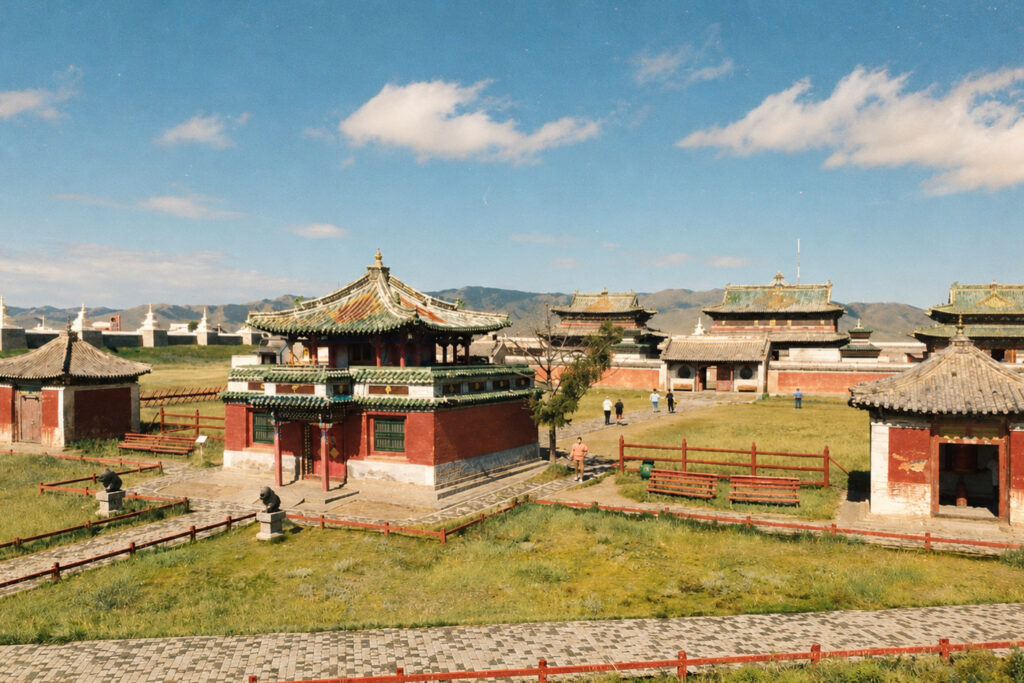
108 white stupas surrounding Mongolia’s oldest surviving Buddhist monastery, built in 1586 from the actual stones of Karakorum — the ancient capital of the Mongol Empire.
You walk the perimeter slowly.
Inside: thangkas darkened by centuries of incense, ritual instruments, masks, manuscripts, robes that have existed here for four hundred years.
Then midday at the Kharakhorum Museum.
Empire maps. Archaeological discoveries. Karakorum artifacts. The vertical script in its historical context. Suddenly the monastery stops feeling like an isolated religious site and starts feeling connected to an entire civilization.
I don’t want you leaving with random facts you forget a week later.
I want you standing there realizing:
this place survived empire collapse, religious suppression, Soviet destruction, and time itself,
and somehow still feels alive.
Then we have something that will stay with you forever.
Private calligraphy workshop with Tamir Purev. Two hours. Ink, vertical strokes, breath.Tamir’s grandmother physically hid Mongolian vertical script manuscripts through Soviet censorship. Authorities wanted the script erased from existence. She refused. Tamir is one of a small number of people keeping the living practice of it alive today.When you sit in this workshop, you are sitting in a lineage that outlasted an empire’s attempt to destroy it.
Your hands made something that didn’t exist before you made it. Your body files that away.
You take your piece home.
Days 6 and 7 — THE ROAR
Tsetserleg, Arkhangai · July 10–11
This is why the tour exists.
Naadam in Arkhangai Province. Not Ulaanbaatar. Not a stadium.
I’ve done the opening ceremony in UB before. Trust me, you do not want to spend three hours in traffic surrounded by tour buses. So we chose something different: a valley, open steppe, real provincial Naadam.
The horse race runs across the land itself. The wrestlers are not performing for cameras. And by Day 6, you are not arriving here cold.
You’ve already been on horseback. Slept on the steppe. Held the ancient script in your hands in Kharkhorin.
Naadam is over 2,200 years old. It began as military training during the Xiongnu Empire and never disappeared. Wrestling. Horse racing. Archery. The eagle dance. The blessing chants over the winning horses. This is not a revival.
It never stopped.
Day 6 — Opening Ceremony
You now see the opening ceremony differently from everyone else, because you understand what you’re watching. After 5 days with me, here you now know it’s not just a concert, generations of symbolism, memory, and ritual still alive.
Your chest does something when you watch it done right.
You’ll know when you feel it.
That evening: airag with local families, fermented mare’s milk, the social glue of Naadam. And if you want to try some of the games yourself, I’ll make it happen
Day 7 — the horse race.
The ground shakes before you see them. Hundreds of horses. Child jockeys lying flat on their necks, ages five to thirteen. Your body doesn’t wait for your brain to decide how to feel.
The Giingo blessing is sung by an elder at the finish line. The winning horse’s sweat is rubbed on spectators. That’s khiimori transferred body to body, the way it has always been done.
This is the moment the whole arc was built toward. By now you have been on horseback, made something with your hands at the ancient capital, felt the moriin khuur in your chest. When the horse race floods you, there is nothing separating you from it. That’s not an accident. That’s the design.
Day 8 — Water
Tsenkher Hot Springs · July 12
Two days of Naadam. The sound, the crowd, the horses, the ceremony. Your body was loud.
Now it gets quiet.
Tsenkher’s springs reach 86°C at the source. Cooled to safe bathing temperature. A river valley with birch and larch. 50 kilometres south of Tsetserleg. It doesn’t announce itself.
Zero programme. No cultural content. No itinerary. You get in the water.
After a peak experience your nervous system needs to come down from it, to settle into whatever it just became. The water does that. If you want to talk about what happened at Naadam, talk. If you want silence, perfect. Both are right.
Day 9 — Ground
Orkhon Valley · July 13
A nomadic family in the Orkhon Valley. Not a cultural exhibit. Not a performance. A family living their life, briefly joined.
A Mongolian ger is a cosmological instrument. Door faces south. Right side for women, left for men. The crown opening reads the time of day like a clock. You’re living inside a working compass and calendar.
Herding with the family, horses, sheep, yaks. A buuz workshop, the Mongolian dumpling, made together and eaten together. I walk you through the ger cosmology before you enter so you can notice it consciously when you’re inside.
They’re not performing for you. They’re just living. You’re briefly part of it.
Evening: fire, sky, silence. The new version of you holds in ordinary, unperformative reality. That matters more than you think.
Day 10 — The Peak
Tövkhön Monastery, Khangai Mountains · July 14
Zanabazar chose this place as his retreat when he was just 14 years old. A granite pinnacle hidden deep in the Khangai mountains. He created the Soyombo script here, the symbol now on Mongolia’s flag and banknotes. He helped shape a distinctly Mongolian form of Buddhism during one of the most politically unstable periods in Mongolian history, preserving identity through art, ritual, language, and philosophy.
Almost no commercial Mongolia tours include Tövkhön. Most go to Erdene Zuu and consider the cultural requirement complete. That’s the point.
60 to 90 minutes hiking through pine forest to reach Tövkhön Monastery.
A meditation cave still used by monks.
Then the rebirth passage, a narrow crack in ancient rock you physically squeeze through one breath at a time. Mongolians believe you leave part of your old self behind when you pass through it.
I added this stop because I’ve done it myself, and it genuinely changed something in me internally. It’s impossible to fully explain the feeling afterwards. So instead of trying to describe it, I decided to bring you there and help you move through it yourself.
From the summit: the Orkhon Valley below. The family you stayed with the night before. The direction of Naadam. The shape of the landscape that held the entire journey together.
The physical effort earns the altitude. That’s not a metaphor either.
Day 11 — Sky
Ursa Major Lodge · July 15
The stars have been above you since Day 3. Tonight is when you understand what you’re looking at.
Doloon Burkhan, the Seven Saints. What you call the Big Dipper. Altan Gadas, the Golden Nail. What you call Polaris. In Mongolian cosmology the entire sky rotates around Polaris like a ger rotates around its crown. The sky is not decoration. It is a navigation system that nomadic peoples read across thousands of kilometers of steppe for thousands of years.
Every nomad, every shaman, every Naadam wrestler since the Bronze Age has looked at the same Polaris. Tonight you’re in that line.
Telescope session. Mongolian star names. Constellations as navigation. The largest possible frame around everything that happened on this trip.
Day 12 — Return
Ulaanbaatar · July 16
Five-hour drive back to Ulaanbaatar. Last group dinner.
The trip is over.
What is not over is the khiimori.
What you bring back is not just a collection of experiences. It’s a different relationship to your own energy. For nearly two weeks, you lived in a place where khiimori, whether a person feels truly alive, aligned, and present, is still taken seriously at the level of daily life.
That does not wash off easily.
Research on narrative identity suggests that immersive experiences don’t just give you memories. They change the framework through which you understand your own story afterwards.
You leave with your khiimori raised.
And that carries into whatever is already waiting for you next.
What was raised at Naadam, grounded in the Orkhon Valley, seen from height at Tövkhön, and placed inside the sky — this returns home with you. Not as memory. As a new set point.
The Arkhangai Naadam Passage
July 5–16, 2026 · 12 days · Maximum 7 travelers · $4,190 per person