I went to Naadam in Ulaanbaatar last summer. Three hours of traffic to get there. Then slow movement with the crowd, you go at the speed of 50,000 people who also decided today was the day. I spent most of it trying to see past someone’s shoulder, or watching the big screen that was showing me the wrestling happening somewhere in front of me. Around me, tourists photographing things they’d never been told the meaning of, open-mouthed, like it was Cirque du Soleil. Nice show. No idea what any of it meant.
That’s not their fault. Nobody told them.
I had, at that point, spent months reading. Traditional Mongol culture, folklore, the actual history of Naadam , how old it is, what the devekh means before it was sport, what the blessing at the horse race is doing, where the wrestling titles come from. Once you know that, you see a completely different thing in front of you. And I’m standing there watching this crowd experience it purely as spectacle and thinking: this is fixable.
Then I looked at what 2026 means for Kharkhorin specifically.
And I stopped thinking about fixing Naadam. I started building a route around a convergence of dates that won’t happen again in my lifetime.
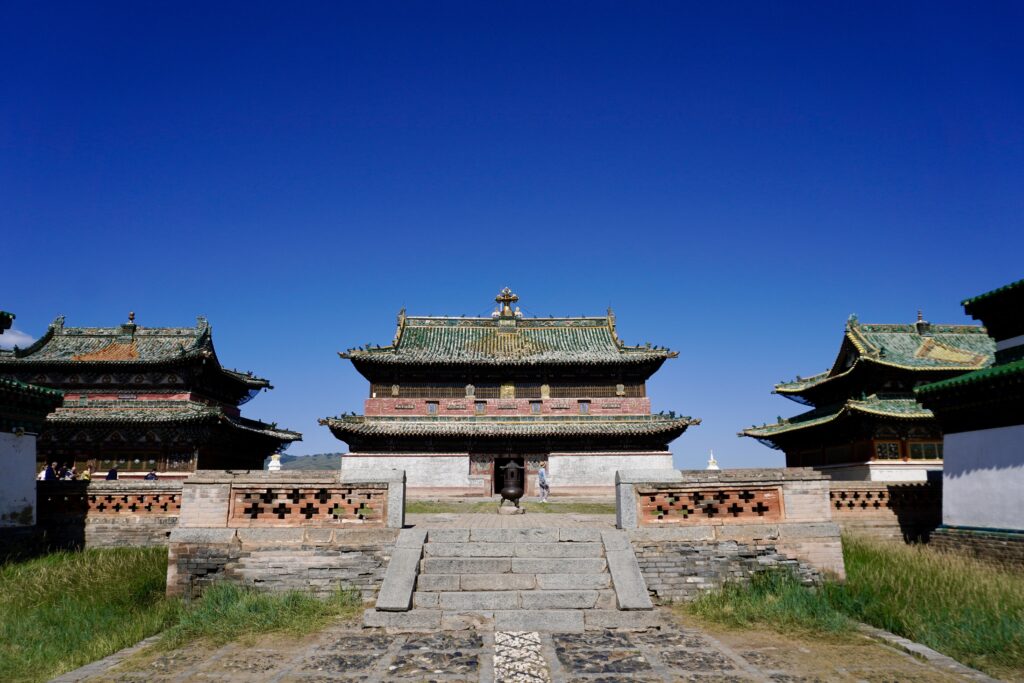
In 1206, Chinggis Khan founded the Great Mongol State, this year is its 820th anniversary. Erdene Zuu, the first Buddhist monastery in Mongolia, was built in 1586 from Karakorum’s own stones, 440 years ago. And Kharkhorin soum, the modern settlement on the ancient capital’s ground, holds its 70th anniversary Naadam this July. All of that converges in the same valley. This year only.
That’s why this tour is called the 820. And that’s why it runs once.
Day 1: You arrive. That’s it.
No orientation session. No group activity. No itinerary briefing.
Airport pickup, hotel, dinner. Your khiimori, the wind horse, the animating force inside you, is at its lowest right now. You’re still in transit mode. Still managing. Still performing whatever version of yourself you’ve been running on for months.
Day 1 is landing. That’s all it needs to be.
Day 2: UB. Before you can understand what survived, you need to know what was taken.
Most tours treat Ulaanbaatar like a transfer point. Rush through, tick the box, get to the steppe. They do this because nobody on the tour knows what they’re looking at. So they skip it.
We don’t skip it. Because the whole arc of this tour depends on you understanding a specific thing before we drive west. The Chinggis Khan Museum tells you the version they didn’t teach in Western schools. The Mongol Empire was not just a war machine, that’s the lazy version, and they needed you to believe it for a reason. You’ll see the physical evidence that proves otherwise. I will share with you the part of history that guides skip. How the script was banned. How hundreds of monasteries were destroyed. My greatgrandpa was rebuilding one. History was rewritten so that “nomad” became the polite word for primitive.
They needed you to believe Mongolia was primitive. Think about why.
That evening at dinner, we talk about khiimori for the first time. What it is. Where it lives. Where we’re starting from. And I explain what we’re actually driving toward, not just Naadam, but 820 years of something that should have been erased multiple times and wasn’t.
Day 3: Khustai. The horses.
The first time I went to see the takhi at Khustai, we drove up in a jeep, parked on a hill, and stood outside squinting into the distance. No binoculars. A herd of Przewalski’s horses maybe 400 meters away and we had no way of getting closer. It felt like a car zoo, honestly. Everyone took a photo and we drove back.
So for this tour we go on horseback.
Takhi, the Przewalski’s horse, are the last truly wild horse species on earth. Not descended from domesticated horses. The genetic ancestor of all of them. The original. They went extinct in the wild in 1969 and were reintroduced to Khustai from 1992. You’re watching the return of something that should have been gone forever.
Khiimori means wind horse. When you say the word while you’re on horseback watching takhi move across the reserve, it lands in the body, not the head. That’s the whole point of this day.
You’re on a horse, watching the original horse. Your body understands before your head does.
That night: fire, stars, silence. No walls. No electricity. The first steppe night. Something in your nervous system begins, very quietly, to open.
Day 4: The drive to Kharkhorin. The music that does something to your chest.
Four to five hours west across open steppe. Picnic lunch on the ground, not at a gas station, because that’s the one thing I will never do after my own tour experience. Come on. The drive is not dead time. The steppe opens and keeps opening. By the time we arrive near Kharkhorin you’ve already forgotten what a city felt like.
That evening: traditional music. Moriin khuur, the horsehead fiddle. Live concert at the ger camp.
Here’s what nobody tells you about Mongolian music: it’s not entertainment. In this culture, music is how you raise khiimori. The original method. Your chest knows before your brain does.
I don’t over-explain this in advance. I just say: notice where you feel it.
Tomorrow you’re at the ancient capital. Tonight the wind horse gets its first lift.
Day 5: Erdene Zuu. Tamir’s workshop. The stories that aren’t online.
I went to Kharkhorin the first time on that rushed tour. The guide knew nothing. Walked us through Erdene Zuu fast, pointed at things, said the names. 1 hour total, maybe. Then we left.
I came back alone after that, with the research I’d done, and spent two hours going through everything slowly. And I got goosebumps at the smallest details. The 108 stupas aren’t decorative, 108 is sacred in Buddhist practice. The monastery was built from the rubble of Karakorum itself, the empire quarried and repurposed into something new. The Soyombo symbol on the gates is the same one on Mongolia’s national flag, created by Zanabazar at Tövkhön in 1686. Every single thing you’re looking at carries a story that most guides don’t know and most tourists never hear.
I have spent time in archives and with sources that gave me access to accounts of Kharkhorin that aren’t written in English. Almost impossible to find. The fact that I have a connection to them is, honestly, unusual. I’m not going to post that material online. It deserves to be spoken on the land where it happened, to people who have been prepared to receive it. That’s what Day 5 is.
After Erdene Zuu and the museum, we have a private session with Tamir Purev. Tamir writes in traditional Mongolian vertical script, the script the Soviets banned. His grandmother worked in Soviet censoring offices and instead of destroying the manuscripts she was ordered to destroy, she hid them. He learned from those manuscripts. The line is unbroken because she refused to break it.
Two hours of ink, vertical strokes, breath. You make something and take it home. This is not a craft class. It is a transmission from a lineage that survived an empire’s attempt to erase it, which is very much what we’ve been talking about since Day 2.
Your hands made something that didn’t exist before you made it. Twice. Your body files both away.
Tomorrow the drums start.
Days 6 and 7: The Anniversary. 820 years and one morning in July.
Kharkhorin soum 70th Anniversary Naadam. On the ground where the Mongol Empire held its court. With Erdene Zuu’s 108 white stupas visible from the wrestling grounds. With instruments from 1696 playing behind the wrestlers. The monastery that was built from Karakorum’s stones is literally watching the games that Karakorum’s empire formalized. That view does not exist at UB Naadam. It does not exist anywhere else.
By this day you know what you’re looking at after my 5 days of storytelling that was preparing you for today. You know what the devekh is before it’s sport and now noticing the smaller cues. You know what the Giingo blessing at the horse race finish actually does. You know why the child jockeys matter. You’ve been on horseback. You’ve held the script. You’ve heard the moriin khuur do what it does to your chest. You are not a tourist who Googled Naadam the night before.
The ground shakes before you see the horses. Now child jockeys lying flat on their necks, ages five to thirteen don’t look that uncivilized anymore. Erdene Zuu’s white stupas in the distance. That image exists only here.
Day 6 is the wrestling. The devekh, arms wide, chest open, expansive, before and after every match. Before it was sport it was prayer. Your chest does something when you watch it done right. That’s not a metaphor.
Day 7 is the horse race. The Giingo blessing song is addressed to the horse’s khiimori, not the rider or owner. The winning horse’s sweat is rubbed on spectators. That’s khiimori transferred body to body, the way it has always been done. I tell you this before the race so you can receive it consciously.
And the specific image that makes 2026 unrepeatable: on this ground, in this year, the Great Mongol State is 820 years old. The monastery watching from its walls is 440 years old. The instruments playing behind the wrestlers are 330 years old. A civilization that survived conquest, dissolution, and Soviet erasure is still here, still playing the games, still counting time the same way. Some places carry everything that happened to them. Kharkhorin is one of those places.
Days 8 and 9: The Orkhon Valley. Ordinary life after extraordinary things.
A nomadic family in the Orkhon Valley. Two days, not one. Because after two days of Naadam’s accumulated weight, the new version of you needs time to hold in ordinary, unperformative reality.
Not a cultural exhibit. Not a performance. A family living their life, briefly joined.
Day 8 is intentionally minimal. Arrival, milk tea, fire. The first evening asks nothing of you. The family understands. After Naadam you just need somewhere quiet to land.
Day 9: dawn horse riding across the valley. Herding with the family. Airag making. Buuz workshop, the Mongolian dumpling, made together and eaten together. Ger cosmology, I walk you through what the structure means before you enter it so you can notice it consciously when you’re inside. Door faces south.
They’re not performing for you. They’re just living. You’re briefly part of it.
The Orkhon Valley has been continuously inhabited since the Bronze Age. The same valley holds Erdene Zuu, the Khangai mountains, the nomadic families who have grazed here for generations. It is not a backdrop. It is the original landscape. And two days here, not one, because the new identity needs time to settle into it.
Day 10: Tövkhön. The loop closes.
Zanabazar built this hermitage at age 20, alone, on a granite pinnacle in the Khangai mountains. He created the Soyombo script here, the symbol you first saw in the Chinggis Khan Museum on Day 2, now on Mongolia’s flag and every banknote. That loop closes today. You were there when it was founded. You held its strokes with Tamir on Day 5. Now you’re at the place it came from.
60 to 90 minutes hiking through pine forest to reach it. A meditation cave still used by monks. Then the rebirth passage, a narrow crack in ancient rock. You squeeze through. What you leave behind is yours to name.
Almost no commercial tours include Tövkhön. Most go to Erdene Zuu and consider the cultural requirement complete. That’s the point.
The physical effort earns the altitude. By the time you reach the top, you’ve left something below that you didn’t know you were carrying.
Day 11: The sky that’s been there since Day 3.
The stars have been above you since the first steppe night at Khustai. Tonight is when you understand what you’re looking at.
Doloon Burkhan, the Seven Saints, what you call the Big Dipper. Altan Gadas, the Golden Nail, what you call Polaris. In Mongolian cosmology the entire sky rotates around Polaris like a ger rotates around its crown. The sky is not decoration. It’s the navigation system that nomadic peoples used to cross a continent. Every warrior, every trader, every ambassador on the Silk Road navigated by these stars. The Mongol Empire, which connected Europe to China, was guided by Doloon Burkhan.
When you look at Polaris through the telescope tonight, you are looking at what every person in this story has looked at, every shaman, every wrestler, every child jockey, every ambassador who rode to Karakorum. The sky is the only thing in this story that hasn’t changed.
Telescope session. Mongolian star names. Constellations as navigation, not mythology. The largest possible frame around everything the last ten days held.
Day 12: You leave. But UB looks different now.
Five hours back to Ulaanbaatar. And here is something that only happens on Day 12.
The city that felt disorienting on Day 1 now makes a different kind of sense. The Soyombo symbol on every flag, every banknote, you know where it was created. Tövkhön. You were there. The Chinggis Khan statue on Parliament, you stood on the ground his successors chose as the center of the world. The vertical script on shop signs, your hands know its strokes. You made them.
The last dinner is not a graduation ceremony. It’s the first meal of whoever you became over the last eleven days. It should feel completely different from the first one. Because you do.
What you bring back isn’t a collection of experiences. It’s a shift in how you relate to your own energy. That does not wash off.
How to go
The Kharkhorin 820 runs July 20–31, 2026. Maximum 7 travelers. $4,190 per person. The 2026 convergence does not repeat. This is the year.